
This year's game Infinite Recharge was based around collecting yellow balls about 18 cm big, which we were supposed to shoot into a hexagon about two meters above ground or place them into an oval shaped opening in about three times lower. After scoring enough balls, we had to rotate a giant wheel either for a specific number of rotations or to a specific position. At the end of the game, the robots had to climb on a moving bar which was about two meters above the ground and if the bar was balanced in the end, the teams were awarded extra points.
Right after the kickoff, we heade out to one of the empty classes where we tried to come up with the ideal strategy. We had 2 options of how the robot should look like. We could build a tall robot that would be able to cross through the center of the field, however, it would be an easy target for defending robots. So we went ahead with the second option: a lower robot that could pass under the wheel mentioned above (also called The Wheel of Fortune) where it was safe from the defending robots.
Considering the chassis, our goal was to maximize the speed and the acceleration of the robot. Unlike last year, high precision when placing the game pieces wasn't necessary, we decided to use 6 wheels west coast drive (or tank drive). After some calculations, we figured out that the best solution is to use three motors on each side of the robot. With help from PrusaLab in Prague, we cut the gearbox profiles on their CNC router. Thanks to the power of six motors, we were able to not only pass the field quicly but if needed, we could take upon the role of the defending robot in the alliance. After one week, we had the chassis ready with weaker gearboxes and we started preparing the electronics.
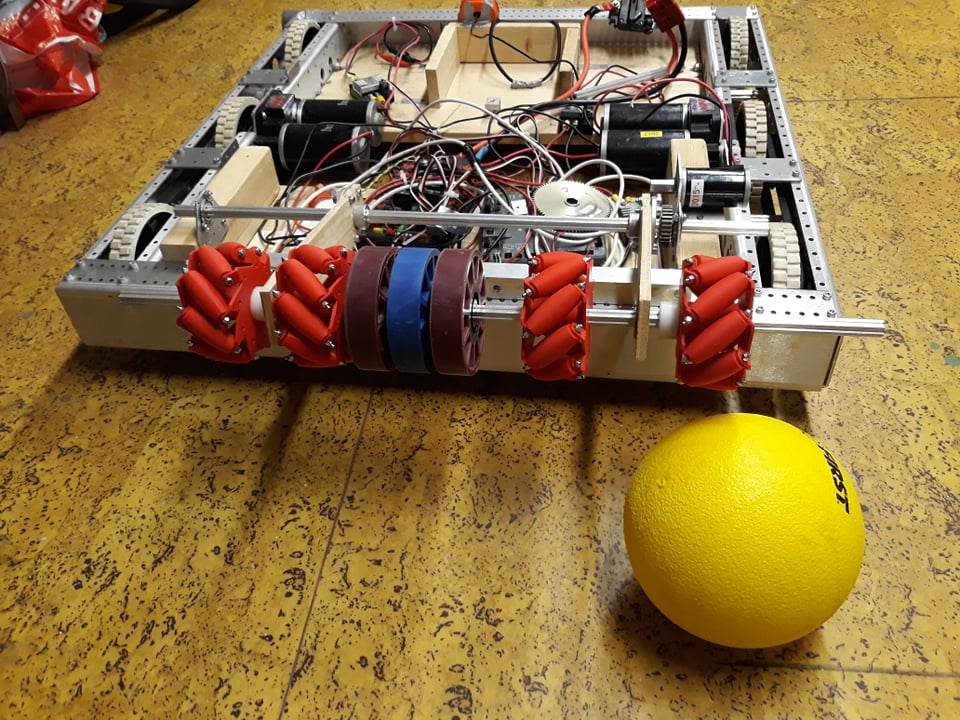
The mechanism for intaking the balls had to be built so that it could intake 5 balls as quickly as possible. From the first drawings of the robot, we intended to use mecanum wheels which would help us to get the balls into the center of the mechanism. The first prototype proved this hypothesis as a feasible one and we were ready to start putting the final manipulator together. Since we had so many motors on our drivetrain, we had to save as many motors as we could, therefore we had to come up with a mechanism that would lift the intake and spin the wheels with a single motor. We were able to achieve this with a servo motor and a simple locking mechanism.
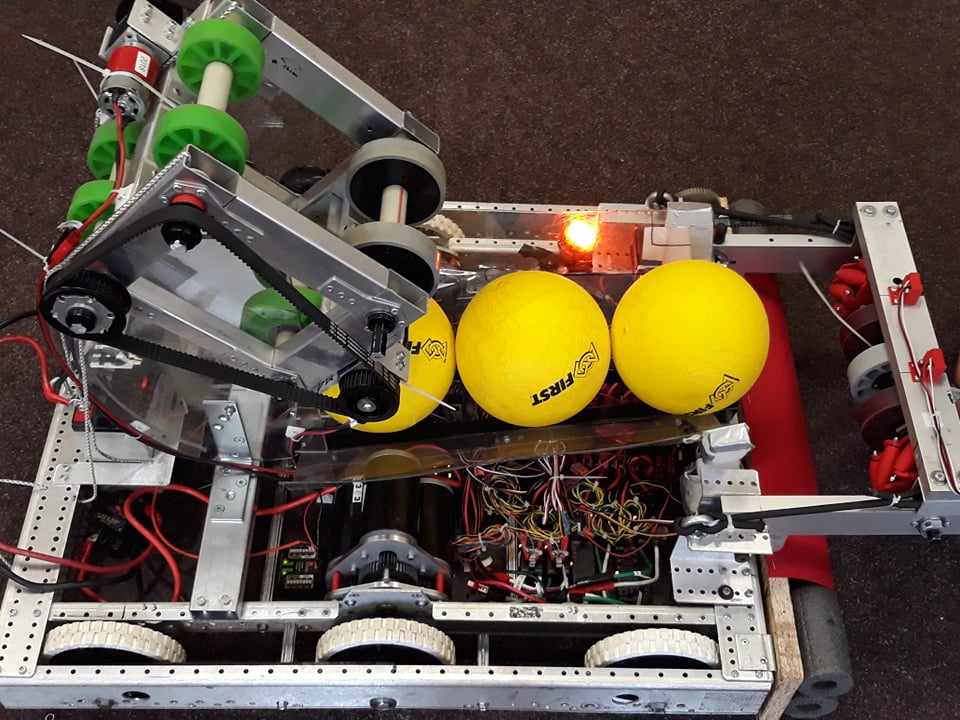
Even on the first night, we had many ideas for the shooting mechanism. Some team members advocated for a mechanism similar to the one from 2017, some for turret which could shoot into different directions without even turning the robot. After creating a simple prototype from two motors and a table, we decided that we could shoot the balls in a straigt line under 45° when we put two wheels right above each other. Then, when we regulate the speed of each wheel, we can shoot the ball with a backspin, which makes the trajectory even longer. We included a system of 3D printed pulleys which could be easily changed to adjust the speed of each set of wheels on the shooter. The balls were stopped right in front of the shooter by a servo motor.
Originally, we wanted to feed the balls into the shooter through a large box where the balls would follow a curved line and rubber wheels between them sould transport them into the shooter. After creating a simple prototype, we figured out that this method is not going to work since the friction between the balls themselves is too large. Another idea was to transport the balls using latex straps which would apply force on the top of the balls and move them around the box. However, due to reasons similar to the previous design, we had to scrap this idea. The final design was using two plastic rails where the balls were transported by the force of gravity. The downside of this design was that we could carry only three balls instead of five.
We created the manipulator for the Wheel of Fortune fairly quickly. The idea was to put some rubber wheels on a gearbox and then put this contraption onto a joint which could be moved with a servo motor. This manipulator wasn't used on the robot because we didn't find a suitable place for mounting.
The last obstacle that we had to overcome before shipping the robot was creating a mechanism for climbing on the bar. Since we decided to create a low robot, we had to figure out, how to fit a 2 meter high mechanism under 90 centimeters of height. The first idea was to shoot a hooking mechanism which would grab onto the bar and lift up a rope for the robot to climb on. A big downside of this is that it requires very precise line of shooting upwards, which we weren't able to achieve due to little amount of reference points under the bar. Another idea that we prototyped was to fold the mechanism into three parts using hinges and passive cylinders that would lift up during the endgame and the robot would lift itself on one of the joints using a motor. In the end, we modified this idea into the final design which combines lifting and rotating the climbing mechanism. At first, the manipulator is raised about 50 centimeters using chains and pulley-like sprockets and then rotating on an axle to gain another 70 centimeters which were ended by simple hooks.
On top of the folded climber mechanism, we fitted our camera which was supposed to help us aim at the vision targets. When testing the robot, we placed the camera on the side of the shooter (using some duct tape), however this position resulted into some misalignments, so we decided to move the camera to help the programming team.
Unfortunately, we never got the robot to compete because of the raising coronavirus pandemic, therefore the only proof of the functionality of the robot is in the section with photos on this website and on our social media.